 English
  Français
  Español
Real example: Logistics and customs costs breakdown for import and delivery to Miami rooftop
Real example: invoice for luxury furniture purchase in Germany and "white-gloves" delivery to Malibu
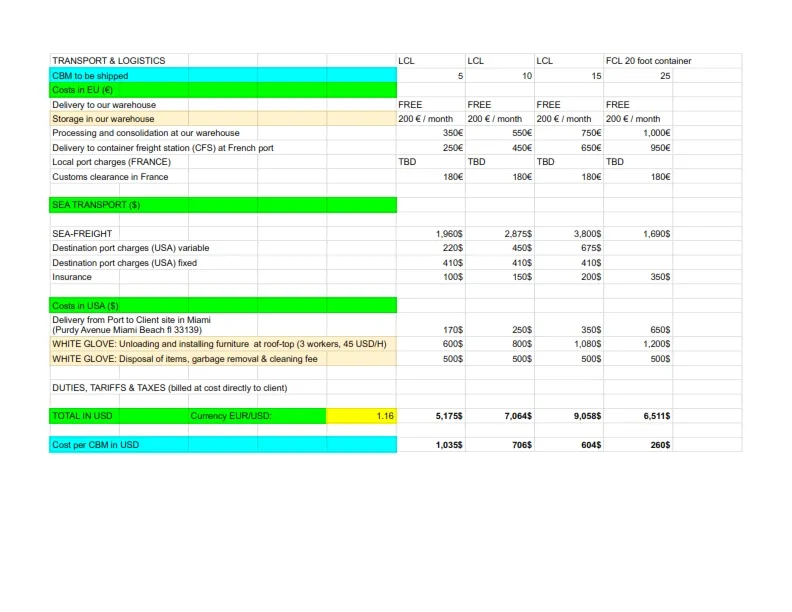




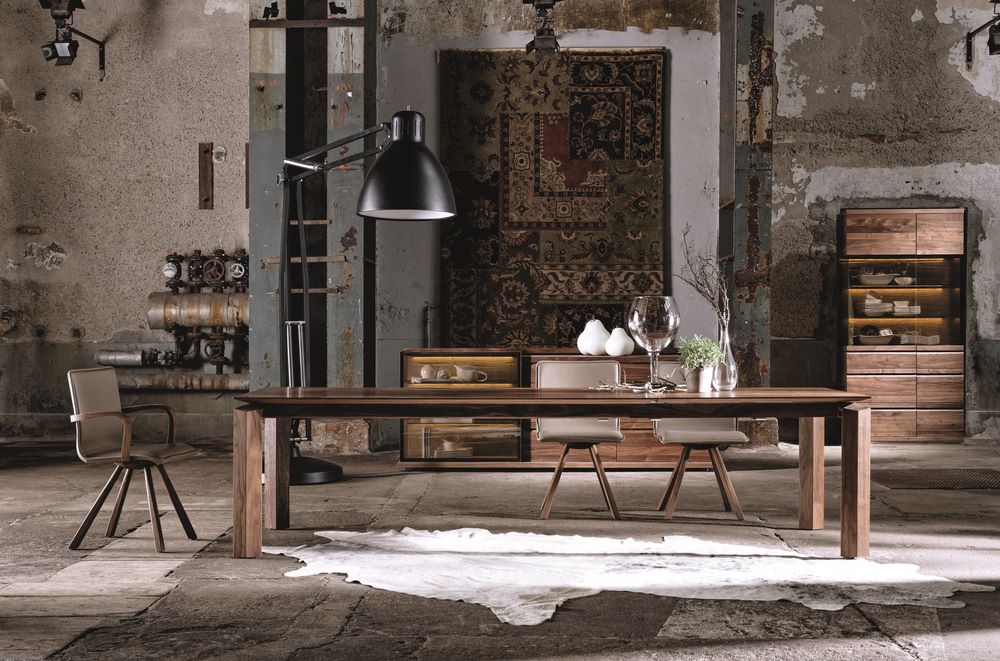



Imagine Outlet Luxury European furniture retailer has written this USA import guide to show you how you can save money by importing luxury furniture directly from Europe
For private residences, Miami rooftops, Malibu villas, New York apartments, Las Vegas hospitality projects, Florida resorts, Aspen chalets and design-led restaurants, importing luxury European furniture directly can be more than a beautiful idea. When sourcing, consolidation, freight, customs and white-glove delivery are handled as one project, it can become a serious financial and design advantage.
Get your USA import quote and save money

Luxury glass table Hystrix Italian design
Importing luxury European furniture to the United States is often discussed as if it were reserved for hotel groups or large purchasing departments. In reality, the model becomes accessible when the project is properly structured. Three practical cases demonstrate the point: a full Miami rooftop furnished under time pressure, a custom solid walnut dining table shipped for a Malibu villa, and an Italian sofa bed imported to a Fifth Avenue apartment at a lower all-in cost than a local US retail checkout.
“Origin fees, air freight, customs clearance, handling, terminal charges and insurance can be itemized before a decision is made. The useful question is not whether furniture can be imported, but which transport route makes sense for the volume, urgency and destination.”
“For large or multiple pieces, consolidation changes the economics. The cost per cubic meter can fall rapidly as a project moves from a few loose items toward a grouped shipment or a full container.”
“White-glove delivery is not an afterthought for luxury furniture. It is part of the import plan, especially when the destination is a villa, private apartment, rooftop, hotel, restaurant or residence with access restrictions.”
The examples below use real product prices, real freight quotation categories and real destination scenarios. They are not presented as fixed universal prices; freight rates, duties, insurance, port charges, fuel adjustments and seasonal capacity move constantly. They do show, however, that importing from Europe to the USA can be concrete, documented and actionable.

The United States has exceptional design showrooms, contract suppliers and retail furniture resources. Yet many of the most interesting European furniture makers still operate in a more selective way: through professional networks, direct factory relationships, interior designers, hospitality projects or carefully controlled distribution. For a buyer in the USA, the opportunity is to move closer to the source.
When a project requires distinctive outdoor sofas for a Miami rooftop, a custom table for a Malibu villa, refined dining chairs for a Las Vegas restaurant, Italian sofa beds for a New York pied-à-terre or a complete furniture package for a Florida hospitality space, buying locally is not the only path. Direct importing can expand the available universe of products and may reduce the final cost on selected pieces.
The real attraction is the combination of design culture, material knowledge, small-batch manufacturing, custom finishes and project flexibility. Italy remains strongly associated with sofas, upholstery, lighting and contemporary design. France brings decorative heritage, outdoor elegance and architectural refinement. Germany and Austria are known for engineering, solid wood production and disciplined detailing. Spain, Portugal, Belgium and the Nordic countries add outdoor, hospitality and contemporary contract collections that can be extremely relevant for US projects.
Local retail pricing in the USA often includes domestic showroom costs, inventory risk, distribution margins, freight already embedded in the price, sales taxes and delivery charges. Direct importing does not eliminate costs; it makes them visible. The buyer sees the European product price, inland transport, warehouse or consolidation, freight, customs formalities, insurance, destination charges and final delivery. Once the numbers are transparent, some purchases become clearly attractive.
Importing is most compelling when the item is high-value, difficult to source locally, custom-made, bulky but not excessively heavy, part of a larger group shipment, or required for a distinctive project where design originality matters. It is also effective when a client needs multiple manufacturers coordinated under one purchasing and logistics plan.
From Europe to the USA — sourcing, consolidation, freight, customs coordination and delivery planning.
Not every furniture purchase deserves an international sourcing strategy. But in the American luxury market, there are destinations where design standards, project budgets and the desire for exclusivity make the European route particularly relevant.

Luxury hotels, restaurants and clubs are not simply buying furniture. They are buying guest experience, photo value, perceived status, seating comfort, durability and operational reliability. A rooftop lounge with the right European outdoor collection can become a destination. A restaurant with a custom table, sculptural chairs or refined upholstery can feel more curated than a standard procurement package. A private villa can gain architectural coherence when furniture is selected from manufacturers that understand proportion, material and finish.

REGALIZ table by Royal Botania
Get your USA import quote and save money
The numbers support the idea that importing furniture is not unusual in the American market. The United States is a major importer of furniture, bedding and related interior goods. The EU is also one of the United States’ most important goods trading partners overall. Eurostat reported that in 2024 the European Union exported €531.6 billion in goods to the United States, while importing €333.4 billion from the United States, creating a €198.2 billion EU goods trade surplus with the US. Source: Eurostat, 2024 EU-US goods trade.
For furniture specifically, the Harmonized System category most commonly used for international trade reporting is HS 94, which includes furniture, bedding, mattresses, lamps and related furnishing articles. UN Comtrade identifies HS 94 as the trade category for “Furniture; bedding, mattresses…” and is one of the standard official databases used to analyze international furniture trade. Source: UN Comtrade HS 94.
The US Census Bureau’s trade data also shows the scale of goods trade between the United States and the European Union. In 2024, monthly US imports from the EU were frequently above $45 billion and reached more than $50 billion in several months. Source: US Census Bureau, trade in goods with European Union.
| Indicator | Official figure or reference | Why it matters for luxury furniture buyers |
|---|---|---|
| EU goods exports to the United States, 2024 | €531.6 billion | Shows the depth of commercial routes, documentation practices and freight flows from Europe to the USA. |
| EU goods imports from the United States, 2024 | €333.4 billion | Confirms a mature two-way trade relationship, not an exceptional or experimental route. |
| EU goods trade surplus with the USA, 2024 | €198.2 billion | Illustrates the importance of European goods in the US market. |
| Furniture trade category | HS 94: furniture, bedding, mattresses and related articles | Useful for classifying furniture purchases, checking duties and preparing import documentation. |
| US-EU monthly goods import values in 2024 | Many months above $45 billion, with several months above $50 billion | Signals established customs and logistics infrastructure for European goods entering the US. |
These figures do not mean every piece of furniture should be imported. They do mean that European-to-US trade is a normal, large-scale commercial channel. When the furniture is valuable enough, and when logistics are correctly planned, direct importing can fit naturally inside existing trade flows.

ARMADILLO armchair with 24k gold finishes
The following items are all cost components of the total amount you will pay when purchasing furniture in Europe and importing it to the USA:
As you can see, the geopolitical context in 2025 and 2026 with the tariffs that the US has imposed on EU imports have definitely been a hurdle to get through making it much cheaper to import luxury furniture from Europe to Canada in comparison with the US and the 15 to 25% tariffs that have been threatened and whose legality has been questioned. Actually, due to the recent tariffs, it is also cheaper to import luxury furniture from Europe to Singapore than it is to to import currently into the United States of America.
The process begins with the project brief: destination, style, budget, dimensions, timeline, indoor or outdoor use, required finishes, performance expectations and delivery constraints. A Miami rooftop with sun, salt air and hospitality use requires different choices from a New York apartment sofa bed or a Malibu dining table.
Once the brief is clear, the right European manufacturers can be selected. This may include outdoor collections, solid wood tables, Italian upholstery, lounge furniture, dining chairs, lighting, beds, wardrobes, decorative objects and contract-grade items. The aim is not to push one brand but to match the project with credible producers.
At quotation stage, the buyer should see product pricing, estimated production times, packing considerations, transport method options and destination assumptions. For custom-made furniture, the quotation must also specify dimensions, finishes, wood species, fabrics, upholstery, fire-retardant options where relevant and packaging.
If several manufacturers are involved, goods can be received at a warehouse, inspected, grouped and prepared for international shipping. Consolidation is often where the project becomes more efficient. It avoids sending multiple small shipments and helps reduce the cost per cubic meter.
Sea freight is usually more economical for volume and less urgent shipments. Air freight can be surprisingly competitive for certain high-value or urgent items, especially when the final destination makes inland trucking expensive. The Malibu table case below shows how a direct air option into Los Angeles can be close to the sea-route total once New York-to-California trucking is considered.
Typical import work may involve commercial invoice, packing list, bill of lading or airway bill, customs clearance, importer identification, single-entry bond if needed, ISF for ocean shipments, EPA declaration when applicable, Lacey Act filing for relevant wood products, insurance and destination charges. The exact list depends on the product, material, route and importer setup.
Luxury furniture often needs more than curbside delivery. White-glove service may include appointment scheduling, building coordination, delivery to room of choice, unpacking, inspection, basic placement, disposal of packaging and sometimes installation support. For high-rise apartments, resorts, private villas and rooftop projects, this must be planned early.

Rooftops, pools, beach clubs and terraces benefit from European outdoor collections designed around comfort, resistance and visual identity.
Solid walnut, oak, marble, ceramic or sculptural dining tables can become the centerpiece of a villa, restaurant or private dining room.
Upholstery is one of Europe’s strongest categories, especially when design, removable covers, fabric choice and compact dimensions matter.
Restaurants, lounges and hotels can source chairs, stools, banquettes and armchairs that feel less generic than local catalog alternatives.
Beds, nightstands, wardrobes, dressers and occasional furniture can be coordinated across finishes for luxury residences.
Mirrors, consoles, lighting, planters and sculptural objects can help a project feel curated rather than simply furnished.
The following three case studies are based on real quotes obtained from established logistics companies and reflect actual market conditions. They are designed to provide a transparent and practical understanding of the full cost structure involved in purchasing European luxury furniture and importing it into the United States.
Importing high-end furniture requires careful planning and a comprehensive evaluation of all cost components. Packaging, for instance, must meet the stricter requirements of sea or air transport—often involving robust solutions such as heavy-duty wooden crating, which can represent up to 5% of the total order value. Transportation costs from the factory (ex-works) to the port or airport in Europe must also be accounted for, including trucking, handling at container freight stations, and any intermediate logistics services.
Additional considerations include potential consolidation, storage, or quality control during transit, as well as all documentation and export customs procedures required at the EU point of departure. Freight costs, whether by sea or air, must be evaluated alongside handling and unloading charges at the U.S. port of entry, followed by import customs clearance. From there, final delivery expenses include pickup, last-mile transport, and specialized white-glove services for high-value goods. Comprehensive international transport insurance is also essential to protect against damage or loss.
To ensure accuracy and reliability, we work with trusted logistics partners capable of providing complete door-to-door solutions—from the European workshop or factory to the final delivery location in the United States. Every cost element is identified, calculated, and validated in advance, eliminating the risk of unexpected charges or delays.
For international sea and air freight between Europe and the United States, we rely on:
Compass Logistics & Marine LLC
1112 SE 3rd Ave, Fort Lauderdale, FL 33316, USA
Tel: +1 954-526-6672
Email: willXYZ@compasslogisticsmarine.com
https://compasslogisticsmarine.com/
For last-mile and white-glove delivery services, we partner with:
Stacks Logistics
2780 NW 122nd St, Miami, FL 33167, USA
Tel: +1 786-338-5540
Email: accountingXYZ@stackslogistics.com
www.stackslogistics.com

The first example is a Miami rooftop project where the client contacted us only two months before the official opening. The rooftop had a spectacular setting, but the space was still raw and bare. The challenge was to transform it into a warm, functional and visually memorable destination using European luxury furniture that could be sourced, proposed, ordered, shipped and delivered within a tight timeframe.
No interior design plan or complete furniture project was available at the start. The opportunity was clear: a large rooftop, a pool, open deck areas, shade structures, views of the water and the city, and multiple zones that could become lounges, dining areas, conversation corners and hospitality moments.
 |
 |
 |
 |
 |
|
Based on privileged relationships with reliable European luxury furniture producers and long experience in high-end decoration, we were able to create a proposal quickly. The objective was not simply to place sofas outdoors. The objective was to build an atmosphere: relaxed but polished, luxurious but friendly, durable but visually light enough for the rooftop architecture.

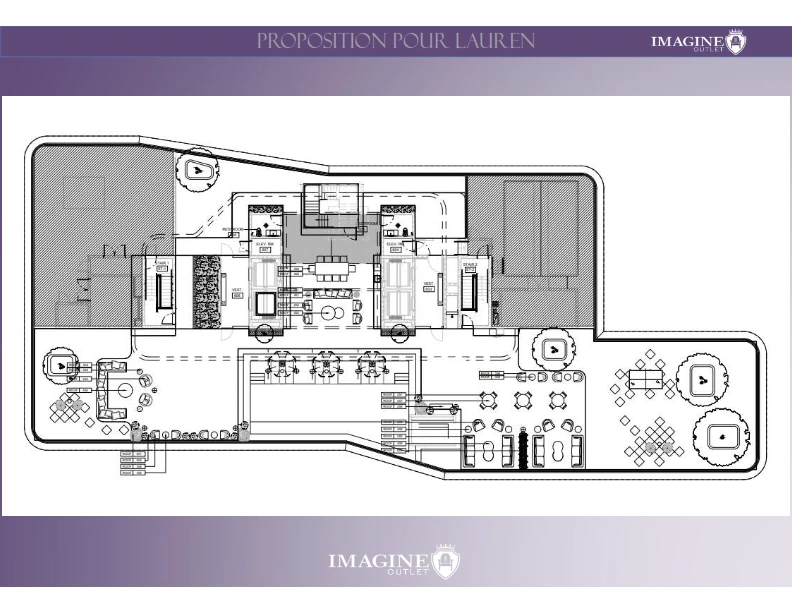

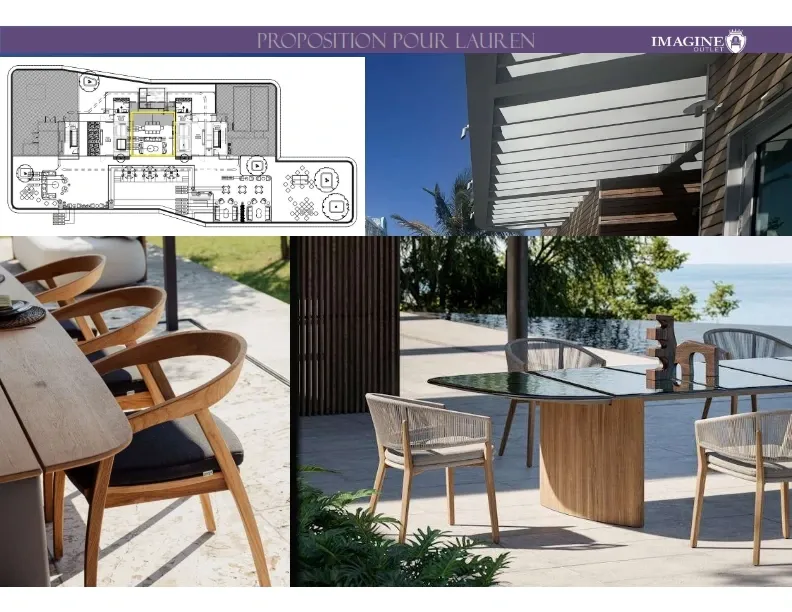


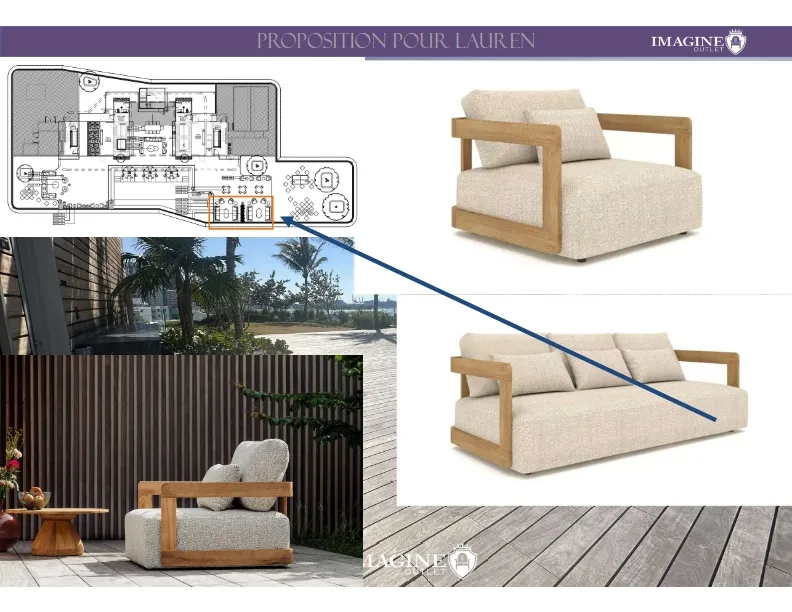

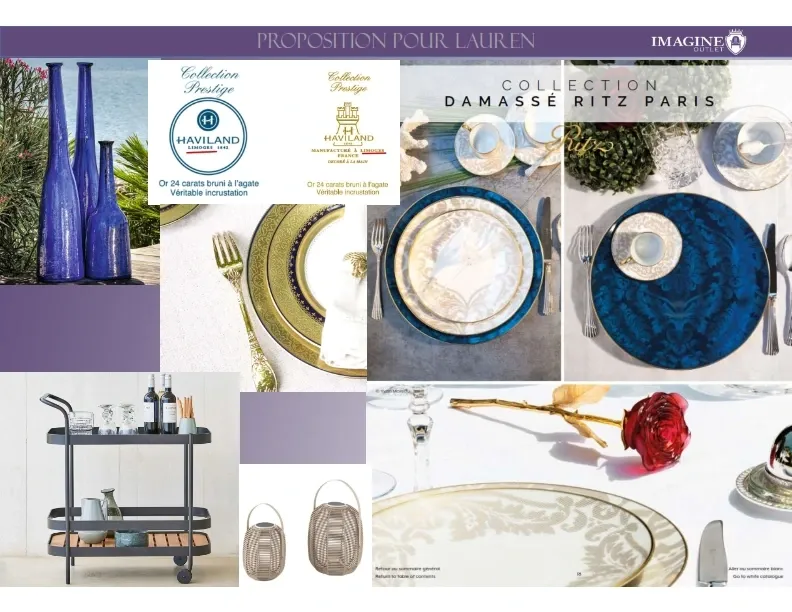


The result illustrates what direct import can do when sourcing and logistics are integrated. The rooftop moved from an unfinished setting to a welcoming destination with lounge zones, conversation areas, hospitality rhythm and a stronger sense of place. This is precisely the kind of project where importing European furniture to the USA can be strategically justified: the space is valuable, the impression matters, and the furniture is part of the commercial or lifestyle experience.

For a rooftop, the shipment may include sofas, modular lounge elements, armchairs, coffee tables, dining tables, chairs, stools, decorative accessories and sometimes planters or lighting. As the cubic volume rises, the logistics cost per cubic meter can decrease. This is why importing a single small item is not always efficient, while importing a complete furniture package can become highly logical.
Send your brief and destination city. We can review sourcing possibilities and logistics structure.

Neolitico glass table designed by Tulczinsky for REFLEX ANGELO
The second case concerns a renowned architecture and interior design studio in California. The studio was looking for a statement dining table for a luxury villa in Malibu. The requested piece was the BOWI table in solid walnut, produced to generous dimensions: 340 x 110 cm. This is exactly the kind of purchase where direct European sourcing can make sense. The table is large, specific, high-value and important to the identity of the room.
The estimate below was based on real logistics documents and market quotations available at the time. It compares sea and air options and shows why the cheapest freight line is not always the cheapest final solution.
| Cost item | Sea freight scenario | Air freight scenario |
|---|---|---|
| Custom BOWI table in solid walnut, ready for shipping from Europe | €10,250 | €10,250 |
| Airport or seaport costs in France | €241 | €241 |
| International freight from France to the USA | €250 to LA route estimate context | €750 direct air estimate context |
| US destination costs excluding tariffs | €1,580 | €1,580 |
| White-glove delivery to Malibu residence, including inspection | €1,170 | €1,170 |
| Total estimated door-to-door cost | €13,491 | €13,991 |
At first glance, sea freight sounds automatically cheaper. In this case, the routing matters. A sea option involving New York and then trucking to Malibu can become close to the cost of air freight directly into Los Angeles. When time matters, when the table is valuable and when the client wants fewer handling stages, air freight can become a rational decision rather than a luxury indulgence.
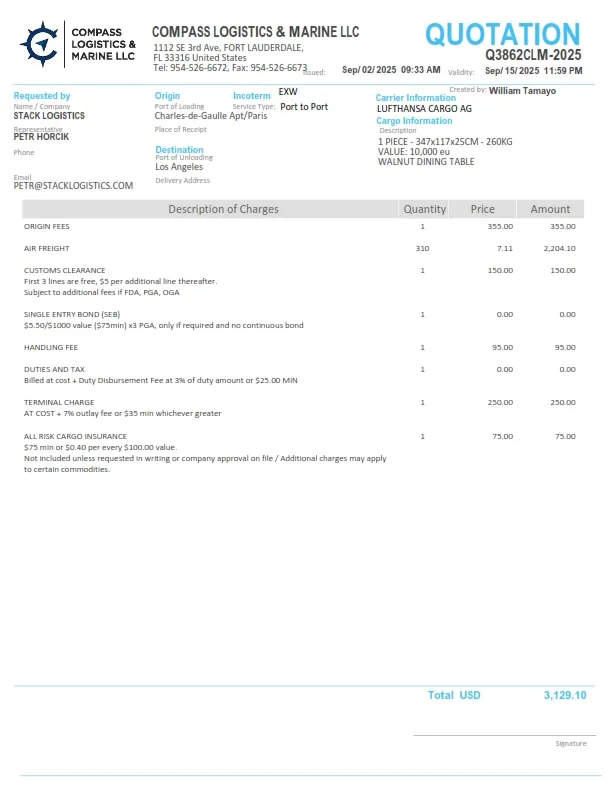
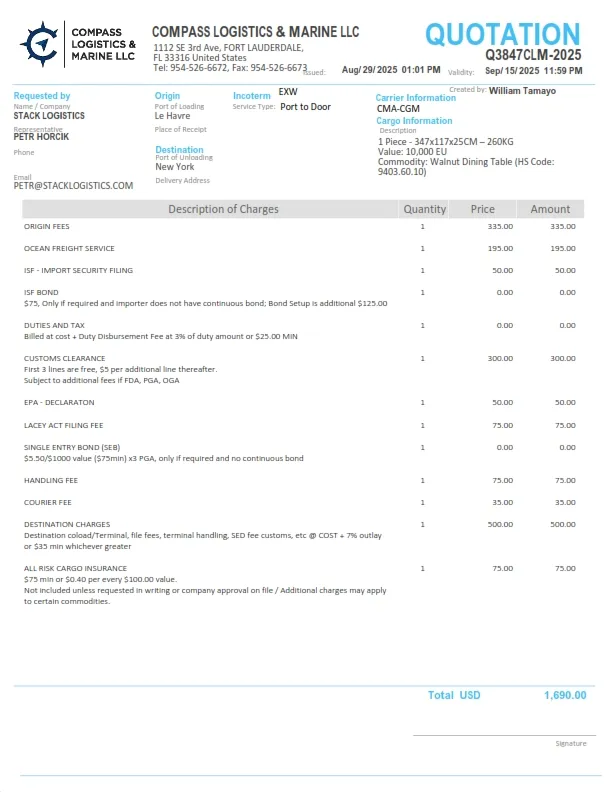
One of the most critical phases of this project was the final white-glove delivery to the client’s residence in Malibu. Given the exceptional size and weight of the custom BOWI table — exceeding 200 kg — standard delivery methods were not an option. The operation required meticulous planning and coordination to ensure both safety and precision during handling.
As reflected in the official quotation from the logistics provider, the delivery was structured around a specialized team of four experienced handlers. This resulted in a total allocation of 32 man-hours (2 × 16 hours), accounting not only for transport but also for careful maneuvering within the property, positioning of the table in the designated dining space, and final inspection upon installation. The total cost for this white-glove delivery service was estimated at $1,170 USD, representing a highly controlled and professional last-mile operation.
Such white-glove services go far beyond simple delivery. They include protective handling at every stage, on-site unpacking, debris removal, and precise placement aligned with the interior design requirements. In high-end residential projects like this one, particularly in locations such as Malibu where access, terrain, and property layouts can present logistical challenges, this level of service is essential to guarantee a flawless outcome.
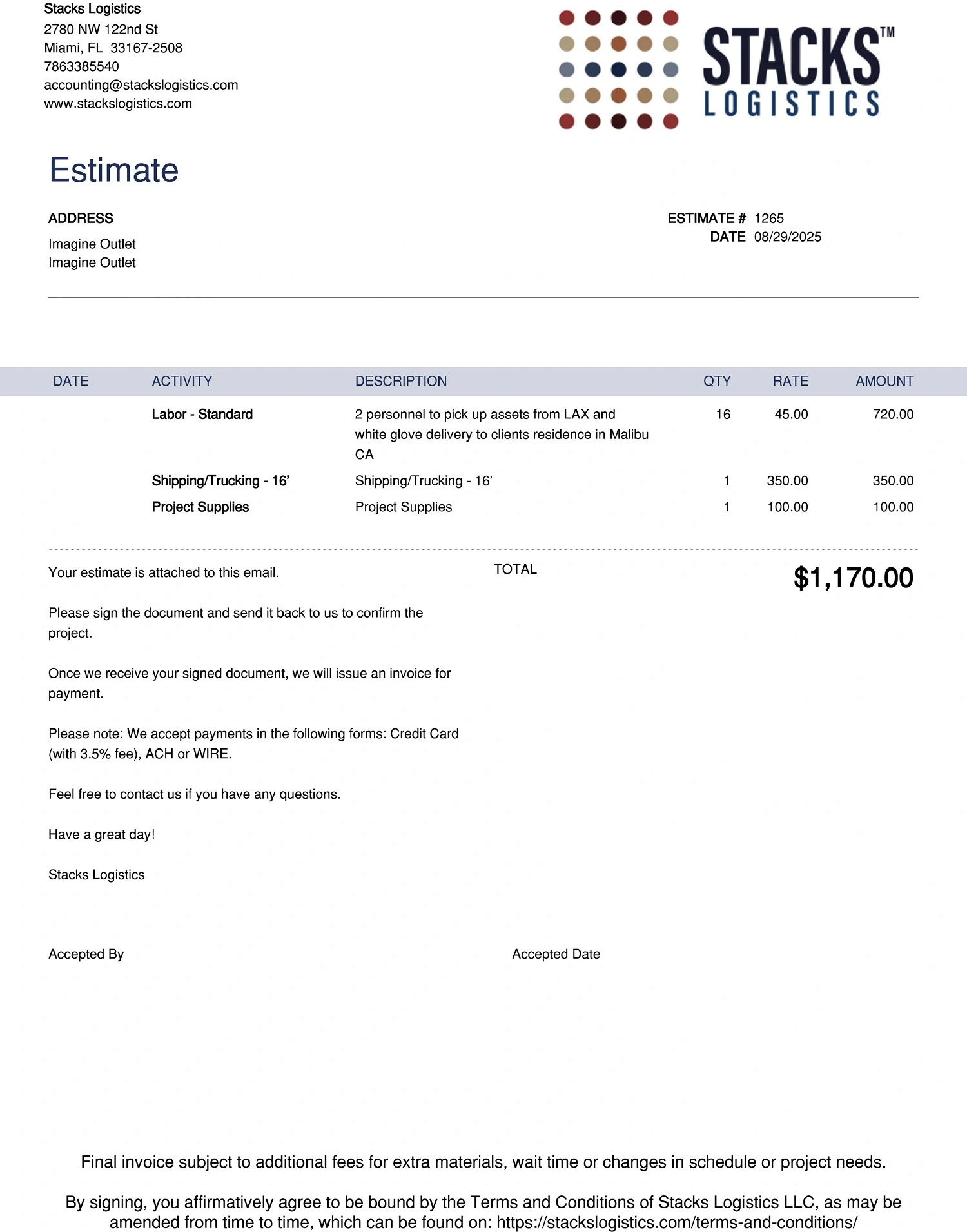
For luxury villas in Malibu, Beverly Hills, Bel Air, Montecito or similar destinations, logistics should be compared door-to-door, not port-to-port only. A freight quote that looks inexpensive can become less attractive when inland trucking, handling, storage, inspection and white-glove delivery are added.

GHOST chair designed by Cini Boeri and Tomu Katayanagi for Fiam Italia
The third case is smaller, but it is very useful because it compares a local US retail checkout with direct European purchasing. The product is an Italian-made sofa bed, the Gervasoni Ghost 11. The recommended retail price in Europe was €2,234. The local US checkout showed a total of $5,931.52 after subtotal, shipping and estimated taxes.
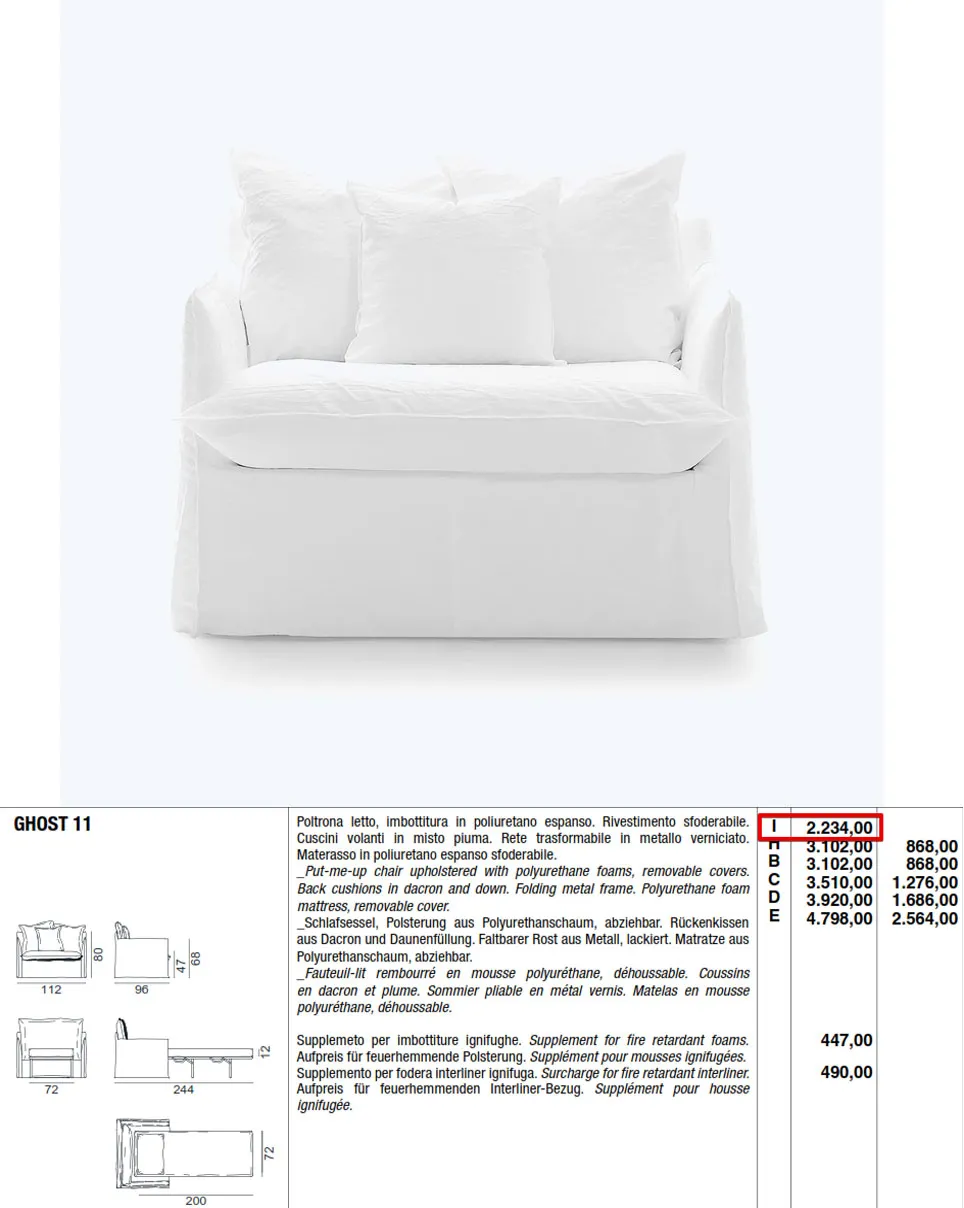
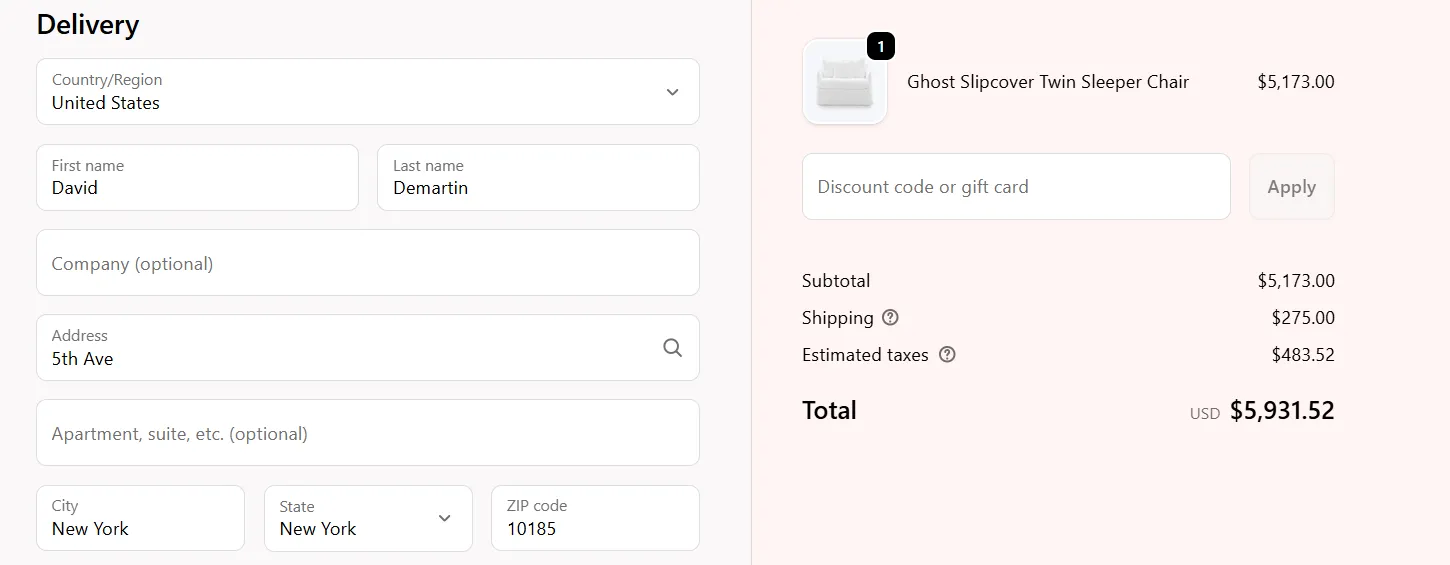
Using the New York route context, the simplified comparison is: €2,234 for the sofa in Europe plus approximately $1,190 for transport and import-related logistics to New York. Final building delivery on Fifth Avenue can still require coordination, appointment delivery and possibly white-glove service, but the route is more direct than a cross-country delivery to California (we have subtracted $500 from the quote in Case Study 2 which included trucking for Miami after shipping via sea from Europe to NYC).
| Scenario | Visible product/logistics numbers | Interpretation |
|---|---|---|
| Buy from US retailer | Checkout total shown: $5,931.52 | Convenient, but includes local pricing structure, shipping and estimated taxes. |
| Buy in Europe and import to New York | €2,234 product price + approx. $1,190 logistics route context | Potentially much lower all-in cost before final variables, depending on exchange rate, duties and delivery details. |
New York is one of the most practical US destinations for European imports. Transit routes are frequent, the market is used to high-value goods, and many luxury apartments need compact, design-led furniture. A sofa bed, dining table, chairs or small apartment package may be easier to justify when the buyer can compare a documented European price against a local checkout.
Sea freight is normally preferred for larger volumes, full apartment packages, hospitality orders, outdoor furniture, dining sets and grouped shipments. It can be organized as less-than-container load or full container depending on volume. The key is to include all destination charges when comparing quotes.
Air freight can be appropriate for urgent openings, high-value items, custom statement pieces or situations where a direct airport route reduces inland transport complexity. It is not automatically the best option, but it should be compared objectively.
Many luxury projects do not come from one factory. A rooftop may involve outdoor sofas from one manufacturer, tables from another, chairs from a third and decorative items from several others. Consolidation allows those goods to be grouped, checked and shipped together.
For luxury projects, the last mile is often the most sensitive stage. A Miami rooftop may need elevator access planning and building rules. A Fifth Avenue apartment may require insurance certificates, delivery windows and service elevator coordination. A Malibu villa may require careful inspection and placement. White-glove delivery protects the furniture and the client experience.

Italian contemporary sofa AUTOREVERSE
Furniture imports into the United States may involve customs duties, merchandise processing fees, harbor maintenance fees for ocean freight, customs bonds, broker charges, state or local taxes, and product-specific filings depending on material. Wood furniture can also require Lacey Act information. Upholstered items may require additional attention depending on materials and end use.
Before committing, ask for the HS code, country of origin, product composition, packing dimensions, weight, delivery address constraints, production time, Incoterms, insurance options, customs broker role and final delivery scope. A luxury import project should never be based only on a product price.
It can be complicated if treated as a casual online purchase. It becomes manageable when sourcing, documentation, freight, customs and delivery are planned together.
Private clients can import furniture, especially for villas, apartments, chalets and large residences. Designers, architects, restaurants and hotels also benefit because they often need multiple items or custom specifications.
It is usually most attractive for high-value pieces, custom furniture, difficult-to-find collections, grouped shipments and projects where several items can be consolidated.
Not always. Sea freight is usually cheaper for volume, but air freight can become competitive for urgent, high-value items or when sea routing creates expensive inland trucking.
Yes, depending on destination and service level. Door-to-door and white-glove delivery can often be arranged, but building access, insurance certificates, elevator dimensions and delivery windows should be checked early.
Yes. Consolidation is one of the major advantages of a structured import approach. It can reduce duplication, simplify delivery and improve cost per cubic meter.
Miami, Palm Beach, Naples, New York, the Hamptons, Los Angeles, Malibu, Las Vegas, Aspen and other luxury hospitality or residential markets are strong candidates.
Warranty coverage depends on the manufacturer and product. It should be clarified before purchase, especially for upholstery, outdoor furniture and custom-made items.
No. The examples focus on the sourcing and logistics information provided. Duties, tariffs and taxes should be verified at the time of import because rules and rates can change.
Prepare destination city, product categories, approximate budget, timeline, style references, room dimensions and any access constraints. Then request a sourcing and logistics quote.

Elisa designer garden lounge
From the finest European manufacturers to your project in the USA — we manage the sourcing and logistics conversation.
Get your USA import quote and save money

When you visit any web site, it may store or retrieve information on your browser, mostly in the form of cookies. Control your personal Cookie Services here.